
How to Use a Counting Scale Accurately (Step by Step)
A counting scale can count 2,000 washers in the time it takes to count 20 by hand. But the number on the display is only as good as the reference sample you gave it. Most counting errors don't come from the scale; they come from a sample that was too small, parts that weren't as identical as they looked, or a container nobody tared. This guide shows how counting by weight works, how to set up a count step by step, and how to work out how accurate your counts really are.
How a counting scale works
Counting by weight is simple division. You put a known number of pieces on the pan (the reference sample) and tell the scale how many there are. The scale divides the sample weight by that number to get the average piece weight (APW). From then on, it divides whatever is on the pan by the APW and rounds to the nearest whole piece:
Count = net weight on the pan ÷ APW
That means any error in the APW is multiplied by every piece you count afterwards. A 1% error in the APW is 1 piece in 100, but 10 pieces in 1,000. Everything below is about keeping that APW error small.
Before you start: is the part heavy enough?
A scale can't count what it can barely weigh. One part should weigh comfortably more than the scale's readability (the smallest step on the display). As a working rule, look for a piece weight of at least a few readability steps.
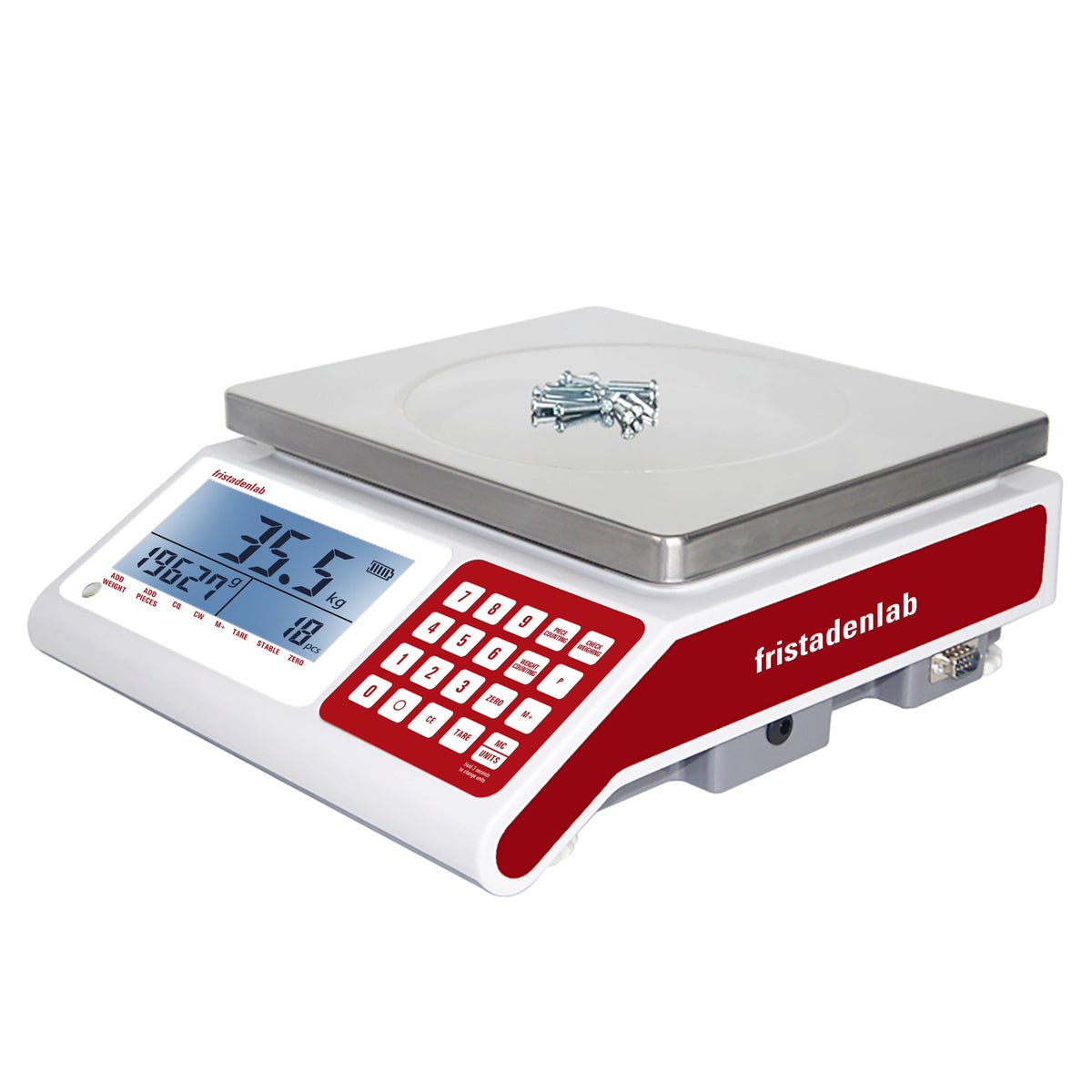
- On the HCS3011D counting scale (15 or 30 kg, 0.5 g readability), parts under 0.3 g can't be counted accurately; parts of 0.3–0.5 g need a reference sample of 50 or more, and parts over 0.5 g need at least 10.
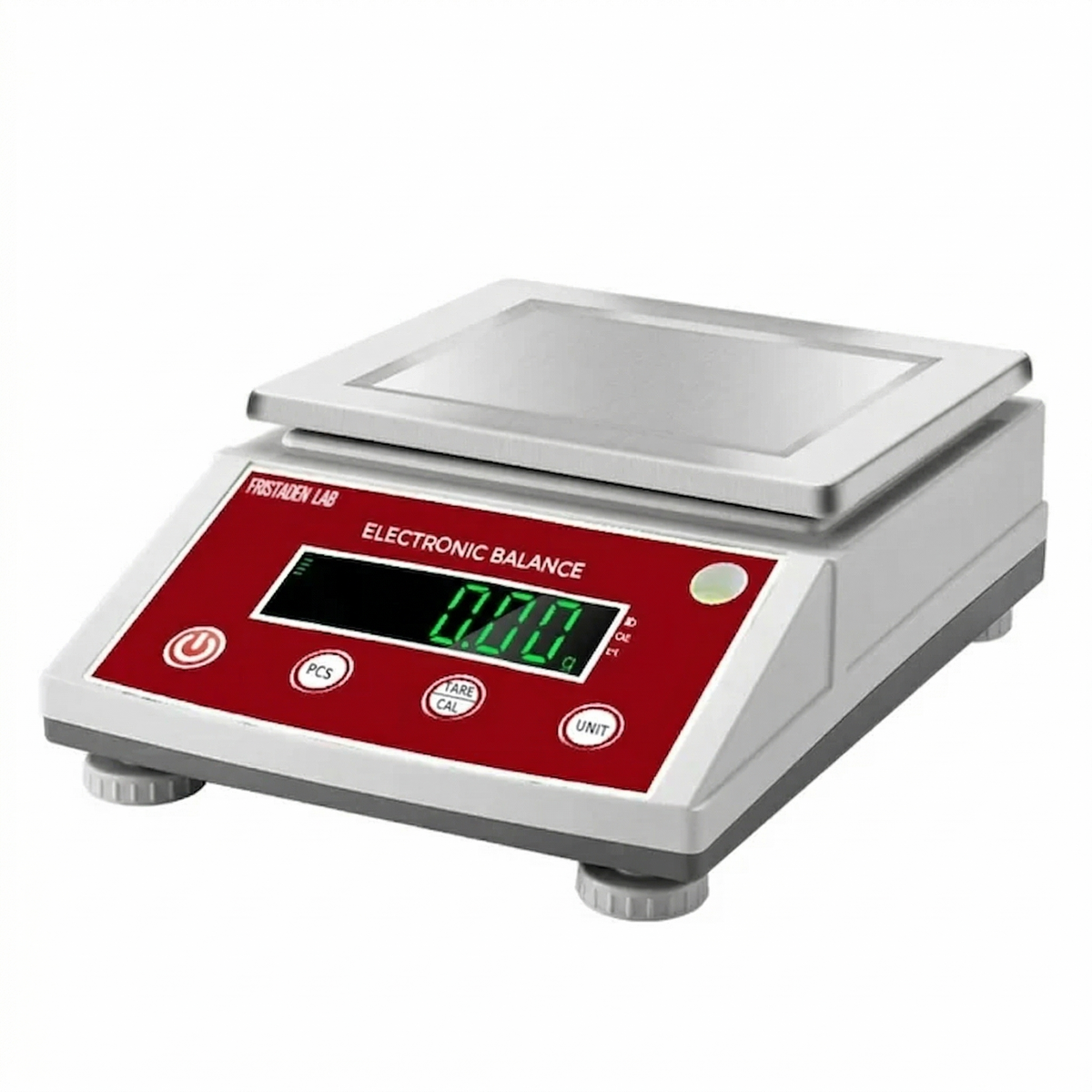
- For lighter parts such as small screws, springs or electronic hardware, use a 0.01 g balance with a counting mode instead, like the HC Series precision balance or the HTP312. The tradeoff is capacity: they top out at 2–3 kg of total load at 0.01 g.
Not sure what readability your parts need? Our readability calculator works it out from the smallest weight you need to resolve.
How to count parts, step by step
- Set up the scale properly. Firm, level bench, away from fans, vents and vibrating machinery. Use the built-in level and adjustable feet. Plug in on AC power if you're counting for a while.
- Zero the empty pan, then tare your container. Put the empty bin, bag or tray on the pan and press TARE so the display reads zero. If you count into several identical containers, check that they really weigh the same before you skip re-taring.
- Count your reference sample by hand. Take pieces from the same lot you're about to count, ideally scooped from several places in the bin rather than the top layer. Count them twice.
- Enter the sample. Place the sample in the container, enter the number of pieces, and set it (on the HCS3011D: type the number on the keypad and press PCS | SET; on the HC Series you choose a 10, 20, 50 or 100-piece sample).
- Add the rest of the parts. Pour slowly near the end so the reading can settle. The HCS3011D settles in about 3 seconds; wait for a stable reading before you write anything down.
- Spot-check. For a new part or a new lot, hand-count one full bag or tray now and then and compare it with the scale.
Model-specific key sequences, the manual and a video are on the counting scale support page.
How big should the reference sample be?
Two things limit the accuracy of your APW, and a bigger sample shrinks both.
1. The scale's own resolution
Suppose you count 2 g washers on a scale that reads in 0.5 g steps, and the sample reading can be off by about one step.
| Reference sample | Sample weight | Possible APW error | Possible error on 1,000 pieces |
|---|---|---|---|
| 10 pieces | 20 g | 0.5 ÷ 20 = 2.5% | about ±25 pieces |
| 50 pieces | 100 g | 0.5 ÷ 100 = 0.5% | about ±5 pieces |
| 100 pieces | 200 g | 0.5 ÷ 200 = 0.25% | about ±2–3 pieces |
The scale's error on the sample gets divided by the number of pieces in it, which is why 100 pieces beats 10 by a factor of ten.
2. Part-to-part variation
No two parts weigh exactly the same. If individual pieces vary by, say, 2% (coefficient of variation), the average of a random sample of n pieces is uncertain by roughly 2% ÷ √n. With 10 pieces that's about 0.6%, or around 6 pieces in 1,000; with 100 pieces it's 0.2%, or around 2 pieces in 1,000. Stamped washers vary little; molded plastic parts, cut wire and coated parts can vary a lot more.
Practical rule: use the largest sample you can count reliably by hand. Fifty to 100 pieces is a sensible default for anything you count often or in large quantities.
Building a bigger sample without counting 100 by hand
You can grow the sample in stages using the scale itself:
- Set the scale with a hand-counted sample of 10.
- Add parts until the display reads roughly 30. Because your first APW is already close, the scale's count at this size will almost always be exact.
- Re-enter the sample as the displayed number (for example, 30) and set it again.
- Repeat, roughly tripling each time (30 → 90), until the sample is large enough.
Keep each jump modest. If you go straight from 10 to 500, a small APW error can put the count off by a piece or two, and you'd lock that error into the new sample. If a displayed count ever looks borderline, count that batch by hand before re-setting.
Counting very light parts with two instruments
If your parts are too light for a counting scale but you have more of them than a 0.01 g balance can hold, split the job:
- Weigh a hand-counted sample (say 100 pieces) on a 0.01 g balance and calculate the APW: sample weight ÷ 100.
- Weigh the bulk lot, net of its container, on the counting scale.
- Divide the bulk weight by the APW and round to the nearest piece.
Example: 100 pieces weigh 48.36 g, so the APW is 0.4836 g. The bulk lot weighs 2,417.5 g net. 2,417.5 ÷ 0.4836 = 4,999.0, so about 5,000 pieces. The bulk reading still matters: at 0.5 g readability, ±0.5 g on 2,417.5 g is about one piece either way, so the result is good to roughly ±1 from the bulk weighing, plus whatever error is in the APW.
Common mistakes
- Too small a sample. Ten pieces is a minimum, not a target.
- Not re-sampling when the lot changes. A new supplier, machine, coating or cut length can shift the piece weight. Take a new sample whenever any of those change.
- Forgetting the container. An untared 40 g bin turns into 20 phantom 2 g washers.
- Mixed or contaminated parts. Counting assumes every piece is the same part. Oil, chips, packaging bits or a few longer screws all inflate the count.
- Reading before the scale settles, or counting on a bench next to a compressor or press.
- Using the scale for sales by weight. Fristaden Lab scales are not NTEP-certified (legal for trade). They're well suited to inventory, kitting, receiving and shipping checks, but not to pricing goods sold by weight.
Keeping counts reliable over time
- Calibrate on a schedule. The HCS3011D is calibrated at the factory; we recommend calibrating once a year, with a weight of at least 20% of capacity (for example 6 kg on the 30 kg model). See how to calibrate a lab balance for the general procedure.
- Use check-weighing for kits and bags. The HCS3011D lets you set high and low limits so an alarm tells you when a bag has too many or too few pieces.
- Record counts automatically if you need traceability. The HCS3011D has an RS-232 port, and the Touch Screen Balance combines a counting mode with USB and RS-232 export.
Choosing between a counting scale and a precision balance in the first place? Read Best Scale for Counting Small Parts and our guide to readability, accuracy and settling time.
FAQ
What is the minimum sample size for a counting scale?
Ten pieces is the usual minimum, and only for parts that weigh well above the scale's readability. For light parts or large counts, use 50–100.
Why does my count drift by one or two pieces?
Usually the APW is slightly off (small sample or a mixed lot), the part weights vary, or the reading wasn't stable. Re-sample with more pieces and check the bench for drafts and vibration.
Can I count parts in a bag or bin?
Yes. Tare the empty container first, then take the reference sample inside it.
How light a part can a counting scale count?
It depends on readability. On a 0.5 g counting scale, parts under about 0.3 g can't be counted accurately; a 0.01 g balance handles much lighter parts at lower total capacity.
Do I need to re-sample every time?
Not for the same lot. Re-sample when the batch, supplier or part revision changes, or when a spot-check disagrees with the scale.


Leave a comment
This site is protected by hCaptcha and the hCaptcha Privacy Policy and Terms of Service apply.