
Artículo: Clinical vs. PRP Centrifuge: Which One Do You Need?
Clinical vs. PRP Centrifuge: Which One Do You Need?
Search for a centrifuge and you'll see two labels everywhere: clinical centrifuge and PRP centrifuge. They sound like different classes of instrument. In practice, most "PRP centrifuges" are compact benchtop clinical centrifuges that are set up and marketed for platelet-rich plasma work. The label matters less than four things: the rotor type, the tubes it holds, how precisely you can set the g-force, and whether your procedure requires a specific validated kit.
This guide explains each of those, shows how to translate a protocol into settings for your machine, and helps you pick the right one.
What a clinical centrifuge does
A clinical centrifuge is a low-to-medium speed benchtop centrifuge (typically a few thousand RPM) built for blood collection tubes and similar 5–15 mL tubes. Its everyday jobs are separating serum or plasma from cells, spinning down urine sediment, and general sample prep in teaching, research and quality labs.
Those jobs need modest force. For example, BD's published guidance for its SST and PST gel tubes is 1,000–1,300 × g for 10 minutes in a swing-bucket centrifuge, or 15 minutes in a fixed-angle one. A clinical centrifuge reaching around 2,000–3,000 × g covers that comfortably.
What makes a centrifuge a "PRP centrifuge"
Platelet-rich plasma is prepared by differential centrifugation: a spin gentle enough to settle red cells while leaving platelets in the plasma, sometimes followed by a second, harder spin to concentrate them. PRF (platelet-rich fibrin) uses no anticoagulant and must be spun within minutes of the draw. None of this needs exotic hardware. What PRP users value is:
- Fine control at low force. PRP spins often sit in the low hundreds to low thousands of × g, so small speed steps matter more than top speed.
- Repeatability. Saved programs, an accurate timer and consistent speed mean every run matches the last.
- The right tube format. Many PRP kits use 8–15 mL tubes; some use larger proprietary tubes that only fit their own centrifuge.
- The rotor type the kit was designed for (more on this below).
One wrinkle in terminology: clinical labs also prepare "PRP" for platelet function testing. BD's guidance for that is 1,500–2,000 × g for 5 minutes from citrated blood. That's a diagnostic sample, not a treatment preparation, and its settings are different from aesthetic or orthopedic PRP kits.
The differences that actually matter
| Factor | Why it matters | What to check |
|---|---|---|
| Rotor type | Swing-bucket rotors lay tubes horizontally, giving flat, level layers that are easy to pipette from. Fixed-angle rotors hold tubes at an angle; they pellet faster but leave a slanted interface. | Which rotor your tube or kit maker specifies. Some tubes are swing-bucket only. |
| Tube size and count | Adapters let one rotor take several tube sizes, but capacity drops for larger tubes. | Your tube diameter and length, and how many you spin per batch. |
| g-force range and step size | Protocols are written in × g. You need to hit the target closely at the low end. | Maximum RCF, minimum speed and speed increment. |
| Programs and timer | Recalling a saved program avoids setup errors in busy workflows. | Number of stored programs, timer range and resolution. |
| Safety features | Blood is a biohazard and rotors carry a lot of energy. | Lid interlock, imbalance or overspeed detection. |
| Regulatory status | For PRP used in patient treatment, the device and kit may need to be cleared or approved together. | What your regulator and your kit maker require. |
How to turn a protocol into settings (step by step)
- Find the force and time in the protocol, in × g. If a protocol only gives RPM, it's tied to the centrifuge it was written on and won't transfer directly.
- Find your rotor radius (center of rotation to the bottom of the tube) in the manual.
- Convert. RCF = 1.118 × 10⁻⁵ × r (cm) × RPM². Our RPM to RCF calculator does it both ways.
- Round to your machine's speed step and recheck the resulting g-force is still in range.
- Adjust time for rotor type if the tube maker gives separate times (like BD's 10 vs. 15 minutes for gel tubes).
- Balance the load. Place tubes of equal mass directly opposite each other; fill a blank tube with water to match an odd tube.
- Save it as a program if your centrifuge allows, so the next run is identical.
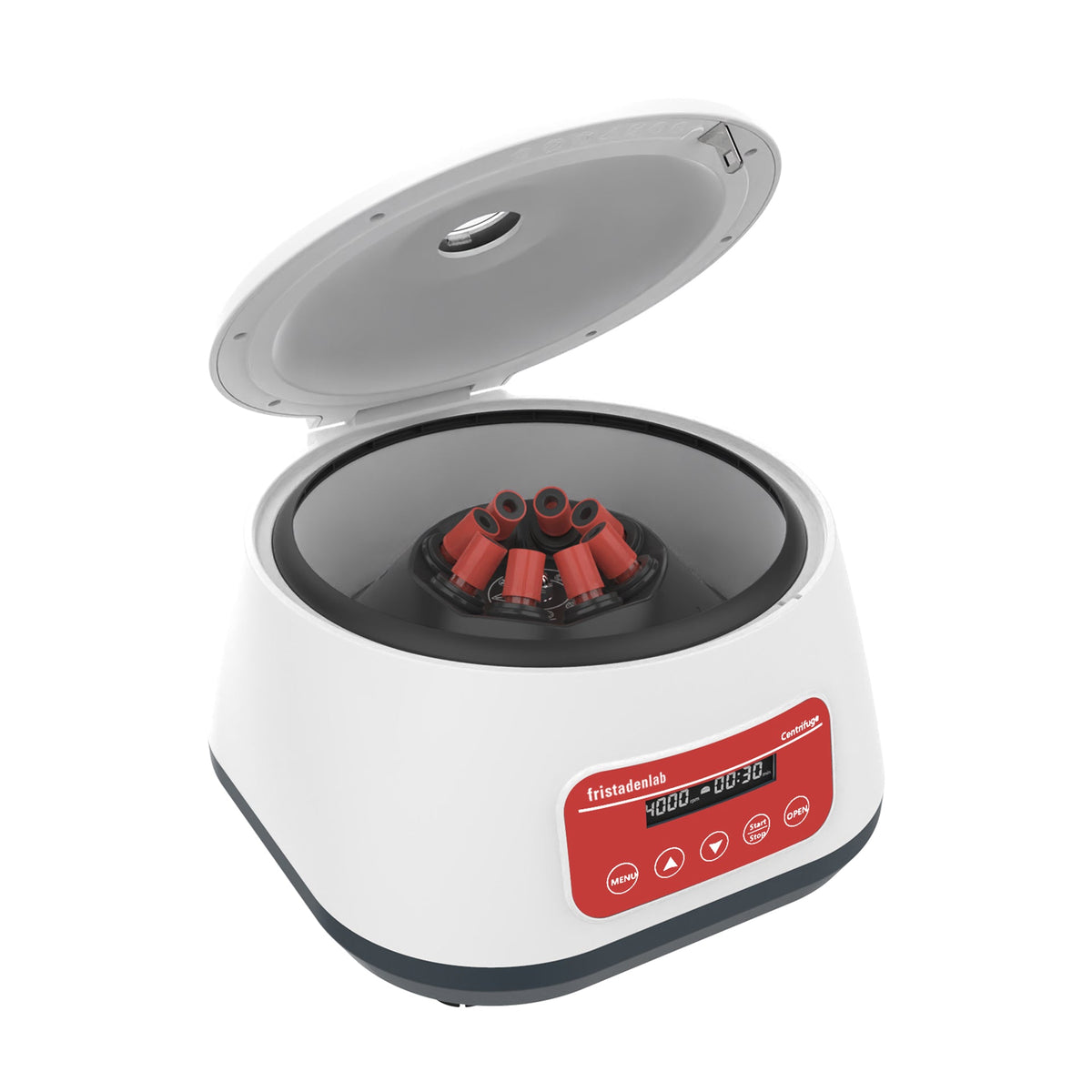
Worked example: a 1,200 × g spin. Working back from published maximums (3,074 × g at 5,000 RPM), the Fristaden Lab LC-6 Clinical Centrifuge has an effective radius of about 11 cm, so 3,100 RPM gives roughly 1,180 × g. Our PRP Benchtop Centrifuge (1,717 × g at 4,000 RPM, about 9.6 cm) needs about 3,300 RPM for a similar force. Same target, different RPM: that's why copying RPM between machines goes wrong.
Common mistakes
- Copying RPM from someone else's protocol. Always work from × g.
- Buying for top speed. Most clinical and PRP work happens well below the maximum. Low-end control and the right tubes matter more.
- Ignoring the tube's limits. BD warns that glass tubes may break above 1,300 × g in fixed-angle heads. Check your tube's rating.
- Using a fixed-angle rotor for swing-bucket-only tubes. Some mechanical-separator tubes are specified for swing-bucket rotors only.
- Unbalanced loads. Uneven tubes cause vibration, noise and wear, and can be dangerous.
- Opening the lid early. Wait for the rotor to stop fully, and open tubes carefully to avoid aerosols from blood samples.
Which one do you need?
Choose a general clinical centrifuge if you separate serum and plasma from blood tubes, run urine sediment, or need a workhorse for teaching or sample prep. Capacity in your tube size and a usable g-force range are the priorities. The LC-6 spins 500–5,000 RPM in 100 RPM steps (up to 3,074 × g), holds six 15 mL tubes in an angle rotor, and has a 0–99 minute timer.
Choose a centrifuge set up for PRP work if repeatable, programmed runs at low-to-moderate force matter most. The PRP Benchtop Centrifuge runs 500–4,000 RPM in 100 RPM steps (up to 1,717 × g), takes four 15 mL tubes or eight 2, 5 or 10 mL tubes with the included adapters, has two quick-start programs, a timer from 30 seconds to 59 minutes 50 seconds, lid-open protection and overspeed detection, and a quiet brushless motor.
Choose a dedicated kit-and-centrifuge system if you prepare PRP or PRF for patient treatment and your kit, clinic protocols or regulator call for a specific validated system. Follow the kit maker's g-force, time and rotor requirements. Our centrifuges don't come with a PRP kit.
You can compare both models on our centrifuges page. If budget is the next question, see How Much Does a Centrifuge Cost?
FAQ
Can a regular clinical centrifuge be used for PRP?
Often, yes, provided it reaches the g-force your protocol specifies, holds your tubes, and uses the rotor type the kit was designed for. If you're treating patients, follow your kit maker's and regulator's requirements.
Is swing-bucket or fixed-angle better?
Neither is better in general. Swing-bucket gives level layers that are easier to collect from; fixed-angle pellets faster. Use the type your tube or protocol specifies, and adjust time if the tube maker gives different times for each.
Why do PRP protocols give such different speeds?
Because RPM depends on rotor size. Two protocols with different RPM can be the same force. Compare in × g using the RCF calculator; the lab equipment glossary explains the terms.
Do I need a refrigerated centrifuge?
Not for routine serum, plasma or most PRP preparation, which are spun at room temperature. Refrigeration matters for temperature-sensitive molecular work.
Sources
Tube centrifugation guidance: BD Vacutainer tubes FAQ; BD centrifugation table (PDF). Fristaden Lab specifications from our product pages.


Dejar un comentario
Este sitio está protegido por hCaptcha y se aplican la Política de privacidad de hCaptcha y los Términos del servicio.